For a long time, we did not treat digital accounts as real assets. They were seen as phone applications, membership systems, temporary technology accounts. Today, for many people, an Apple account is no longer just a tech account. It is a digital identity.
An average Apple account may contain years of accumulated photographs, messages, notes, banking applications, health records, company documents, social media access, gaming accounts, subscriptions and cloud archives. Some people practically store their entire family history inside a single iCloud account.
So what happens when the account holder dies?
Families often turn to the phone first. Does anyone know the password, does Face ID still work, is there an old computer with an active session, was an iCloud backup created? The feeling behind this panic may be simple: if the phone disappears, part of the person disappears with it.
People once opened the drawers of the deceased. Now they try to unlock their iPhone.
And this brings us to the critical question:
Does an Apple account die with its owner?
Technically, sometimes yes. Legally, the answer becomes more complicated. Because an Apple account does not only contain economic value. It also contains private life, personal data and information belonging to other people. That is why Apple accounts do not automatically pass to family members.
You may physically possess the phone, the box, the SIM card and even the death certificate, yet the account may still remain inaccessible. From Apple’s perspective, the account holder is still that person.
For years, inheritance meant houses, land, vehicles, bank accounts, gold or company shares. When someone died, people searched for title deeds, bank records and safe keys. Today, many families first search for the phone.
Apple, meanwhile, has spent years building one of the strictest security cultures in the world. Many still remember the public disputes between Apple and U.S. law enforcement agencies, where authorities demanded access to locked devices and Apple resisted on security grounds.
So can these accounts be hacked?
Movies make it look easy. A few hackers, a few minutes, full access. Reality works differently. Apple accounts and iPhone data are protected by multiple layers of encryption. Some areas are end-to-end encrypted to such an extent that even Apple itself may not directly access them. In other words, even if the phone is physically in your hands, you still may not reach the data inside.
Let us say you start looking for people who claim they can unlock the account. Where exactly would you find them? There is no legitimate, institutional structure openly operating within legal boundaries while advertising Apple account access services. Some may simply be scammers, some may disappear after taking payment, and some may drag you directly into criminal law problems because unauthorized access itself may constitute a crime.
In practice, people are usually left with three possibilities.
The first is losing the account entirely. If nobody knows the password, if recovery information is unavailable and if the deceased never planned any form of digital inheritance, the account may effectively disappear forever. People also ask another question: when does Apple eventually delete these accounts? Apple does not publicly provide a universal automatic deletion period applicable to all inactive accounts. Some accounts may remain dormant for years, some services may expire and some content may gradually become inaccessible. In a sense, after physical death, digital existence may slowly fade away as well.
The second option is the traditional legal route. Certificates of inheritance are obtained, death certificates collected, official correspondence initiated, translations prepared and sometimes international documentation processes become necessary. In Türkiye, the decision of the Antalya Regional Court of Appeal, 6th Civil Chamber, became notable because the court recognized that digital wallets and social media accounts may constitute digital assets carrying economic value.
The third option is the system now developed by technology companies themselves.
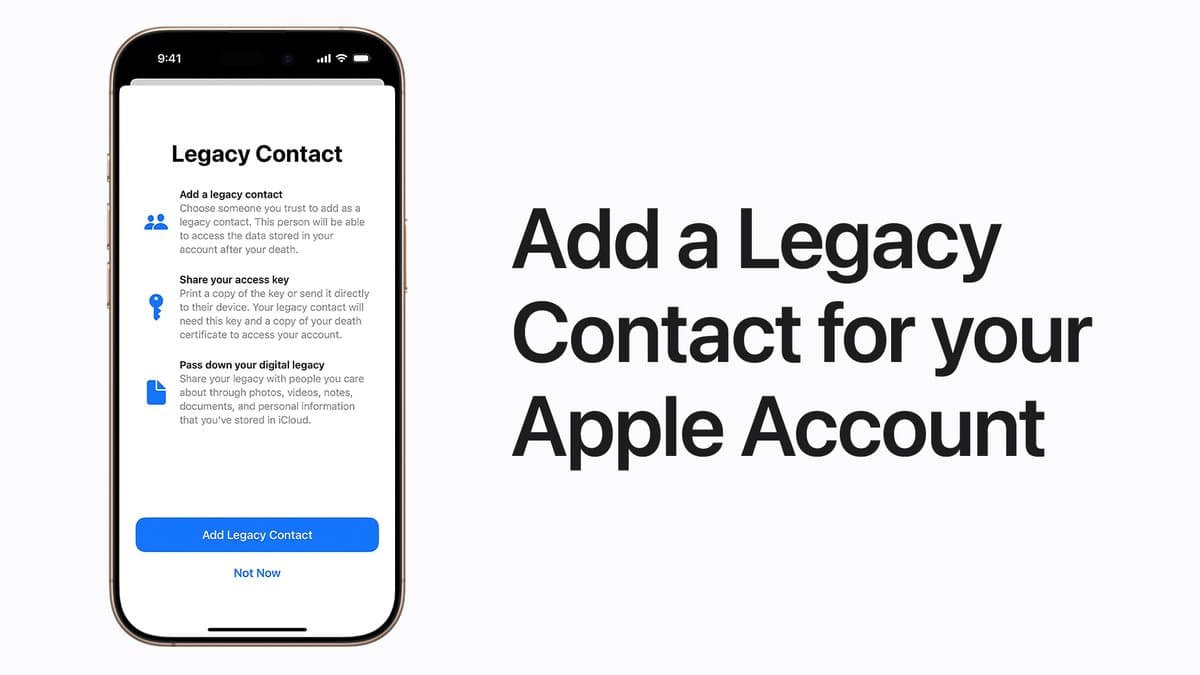
Apple calls it Legacy Contact. The Turkish translation is also surprisingly stylish: Vâris.
Apple’s announcement dated April 16, 2026 reveals how much the world has changed. Technology companies are no longer thinking only about account security during life, but also about account management after death.
While alive, the user can designate one or more trusted individuals for the Apple account. Apple then generates a special access key for those individuals. After death, the designated legacy contact may apply to Apple using the access key together with the death certificate. Once Apple completes verification procedures, limited access to certain data may be granted, though not every category of information becomes accessible.
Photographs, messages, notes, files and device backups may become available.
Modern legal systems, however, were not written with this digital reality in mind. When the Turkish Civil Code was drafted, nobody imagined iCloud accounts, crypto wallets, two-factor authentication systems or digital gaming inventories. The law knew letters, but not WhatsApp backups. It knew physical photo albums, but not cloud archives. It knew safe keys, but not access keys.
Consider a single e-mail account. It may contain family photographs, company secrets, attorney-client correspondence, banking information and crypto exchange access. One account can simultaneously become a personal archive, an economic asset and a repository of third-party personal data.
A deceased person’s phone may contain far more than family memories. There may be deeply private conversations, confidential business materials, sensitive notes and personal data belonging to other individuals. At that point, inheritance rights collide directly with privacy rights.
From a constitutional perspective, the privacy of private life, secrecy of communication and protection of personal data all become relevant. Under Turkish data protection law, the issue becomes even more delicate because the account may include not only the deceased person’s own data, but also messages, photographs and communication records belonging to others.
The situation becomes even more complicated internationally. The deceased may have lived in Türkiye while the Apple account infrastructure operated through Ireland and the data itself may have been stored elsewhere. You may hold a Turkish inheritance certificate while dealing with a multinational technology company governed by foreign legal systems.
Sometimes families are not even trying to recover economic value. They are trying to recover memories. A child’s first video, the final voice recording of a loved one, years of family photographs, old conversations and archives that were never backed up may all remain trapped behind a single password.
As digital life expands, people are slowly returning to classical inheritance planning. The only difference is that the drawer no longer contains a safe key, but an access key. The fully digital world has unexpectedly brought people back to printed documents and secure folders.
The crypto asset side becomes even harsher. In some cases, if the password disappears, the asset effectively disappears as well. Unlike a bank account, there may be nobody to call for recovery. There are serious claims worldwide regarding enormous amounts of cryptocurrency remaining permanently locked in inaccessible wallets.
Crypto inheritance will most likely become the subject of another article of mine.
Even under classical inheritance law, families may spend years fighting each other. Parents avoid planning during their lifetime, and after death siblings turn against one another. Disputes over houses, land, companies and bank accounts may continue for years. In many families, the real problem is not the inheritance itself, but uncertainty. Who knew what, who had access, who hid information, who acted first.
Digital life may amplify this problem because hidden accounts can exist without anyone knowing. Secret investment accounts, secondary phones, unknown crypto wallets and long-forgotten email accounts may suddenly emerge.
Apple’s legacy system is not technically an inheritance distribution mechanism. It is an access mechanism. Apple does not say the account legally belongs to a certain person. It merely grants technical access to a designated individual.
Imagine three siblings. The father designates only one child as the Apple legacy contact. After death, only that child gains account access. Is that fair? Technically possible, certainly. Legally, however, the issue becomes debatable because the account may contain not only memories, but also economic value. Once crypto assets, digital investments or monetized platforms enter the equation, the problem grows substantially.
Apple’s designated legacy contact is not the same thing as a legal heir under Turkish law. Apple provides technical access. It does not definitively determine inheritance rights.
An even stranger debate may arise in the context of inheritance disclaimer. Imagine someone legally rejects the inheritance, yet remains the designated Apple legacy contact. Under Turkish law, rejecting inheritance generally means rejecting rights and liabilities connected to the estate. Apple’s system, however, functions through technical access logic.
Theoretically, someone may reject the inheritance legally while still remaining the technical person capable of accessing the Apple account. Later, crypto wallets or digital investment records may emerge within that account. At that point, what is the legal nature of such access? Possession, custodianship, estate representation, unauthorized use?
Technology companies tend to view death as a technical process. Law views death as a transfer of rights. The two systems do not always align perfectly.
Digital inheritance remains a legal grey zone. Apple’s system appears practical and rational, but the matter extends far beyond technology alone. It intersects with inheritance law, data protection law, privacy rights, estate administration and sometimes even criminal law.
A few years from now, lawyers may no longer conduct only title deed investigations.
They may also conduct digital estate investigations.
And in the end, a poor adaptation of a famous line by Yahya Kemal Beyatlı comes to mind:
For the sake of a single password, my God, how many inheritances are lost. ( I must admit, it sounds much better in Turkish.) Onur PUĞ Attorney at Law